
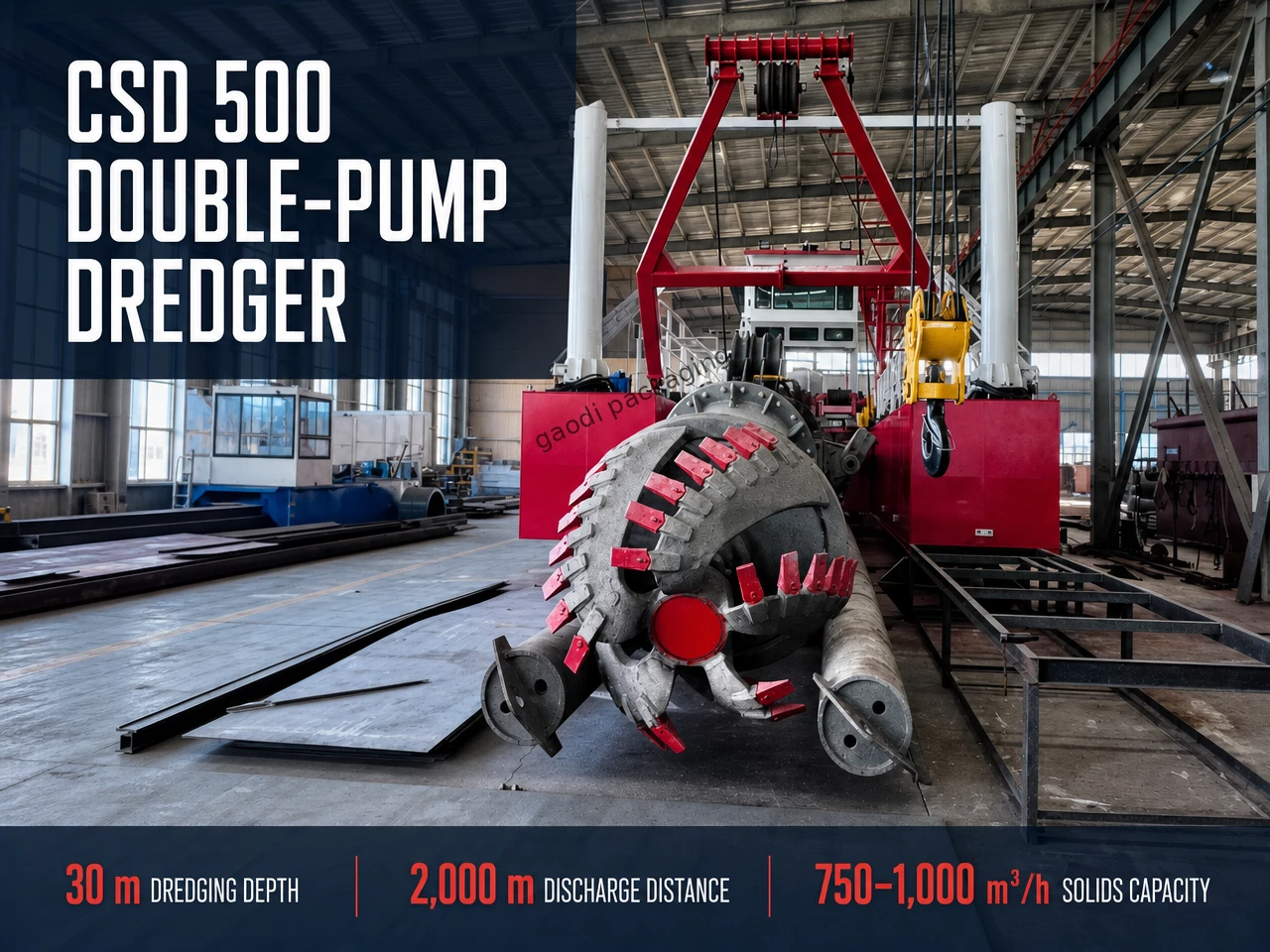
In-Stock CSD 500 Cutter Suction Dredger | 30 m Dredging Depth, 2000 m Discharge Distance
In-stock CSD 500 double-pump cutter suction dredger with 5,000 m³/h water flow, 750–1,000 m³/h solids capacity, 30 m dredging depth, 2,000 m discharge distance, a 400 kW cutter, an in-hull dredge pump, and a submerged ladder pump.
- CE & EPA Certified
- 18-Month Warranty
- Global Parts Warehouses
An In-Stock Dredger for Projects Facing Tight Mobilization Schedules
River restoration, port-basin maintenance, channel deepening, lake rehabilitation, land reclamation, and large-scale sediment transport projects frequently face the same operational constraints: insufficient dredging depth, reduced pumping efficiency over long pipelines, pump blockage caused by variable material, and project delays associated with new-build lead times.
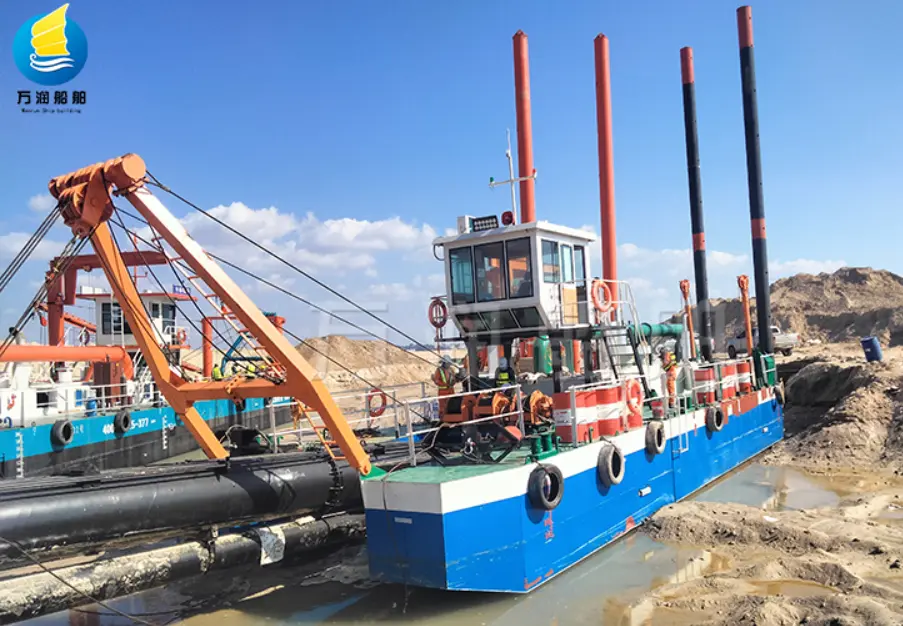
The CSD 500 double-pump cutter suction dredger is currently presented as an in-stock workshop unit. It combines an in-hull dredge pump with a submerged dredge pump mounted on the ladder. The specified configuration provides a maximum dredging depth of 30 m, a design discharge distance of 2,000 m, a water-flow capacity of 5,000 m³/h, and a solids-handling capacity of 750–1,000 m³/h.
Rather than relying on a single headline flow figure, the CSD 500 integrates the excavation, pumping, positioning, and power systems required for deep-water dredging and long-distance slurry transport. This balanced configuration helps project owners reduce the risk of selecting a dredger that does not match actual site conditions.
How Does the CSD 500 Address Common Dredging Challenges?
1. Reach deeper dredging areas without changing the working platform
The dredger has a specified maximum dredging depth of 30 m. Its overall length is 62 m, while the hull measures 52 m long, 10 m wide, and 2.5 m deep, with a design draft of 1.3 m.
This depth capability is suited to port basins, deep river sections, lakes, navigation channels, and projects requiring excavation in multiple layers. It can reduce the need to replace the dredging platform or introduce additional equipment simply because a conventional dredger cannot reach the required depth.
Two hydraulically operated spuds, each 25 m long and 720 mm in diameter, work with the swing winches and positioning winches to support controlled movement across the dredging face. A depth sounder, GPS, and 3D positioning and monitoring system provide operators with essential information about the dredging position and underwater working conditions.
2. Maintain slurry transport over a 2,000 m discharge pipeline
The CSD 500 uses a two-pump arrangement:
In-hull dredge pump:
- 5,000 m³/h water flow, 57 m head, and 1,550 kW rated power;
Submerged ladder pump:
- 5,000 m³/h water flow and 25 m head;
Design discharge distance:
- 2,000 m;
Design discharge height:
- 5 m;
Suction pipe internal diameter:
- 700 mm;
Discharge pipe internal diameter:
- 650 mm.
Positioning the submerged pump close to the excavation point helps improve suction conditions at greater water depths. The in-hull pump then provides the additional pumping capability required for pipeline transport. This arrangement is particularly relevant when the disposal area is far from the dredging zone, the shoreline is difficult to access, or the slurry must travel through an extended pipeline system.
3. Deliver higher solids output within restricted construction windows
The specified water-flow capacity is 5,000 m³/h, with an approximate slurry concentration of 15%–20% and a solids-handling capacity of 750–1,000 m³/h.
For projects constrained by seasonal rainfall, flood-control periods, navigation schedules, or contractual deadlines, a higher hourly solids output can support more efficient production planning and help reduce the time required to complete each dredging section.
Actual production will depend on soil type, particle-size distribution, slurry concentration, discharge distance, elevation, pipeline layout, the number of bends, and the condition of wear parts. A project-specific pumping assessment should therefore be completed using geotechnical data and the proposed pipeline arrangement instead of comparing theoretical flow figures alone.
4. Cut compacted deposits and reduce blockage risk from larger particles
The dredger is equipped with a 2,400 mm hydraulic cutter, rated at 400 kW and driven by four hydraulic motors. Available cutter speeds are 10, 20, and 30 r/min. The cutter head carries 50 teeth to loosen and break compacted deposits before the material enters the suction system.
The in-hull pump uses Cr27 material for its wear-exposed components. According to the technical specification, the pump can pass stones up to 150 mm in diameter. This configuration can help reduce blockage risk in sand, gravel, and mixed-material conditions while providing wear resistance in abrasive slurry service.
For sites containing a high percentage of gravel, irregular rock fragments, or oversize debris, particle-size analysis and representative material sampling remain essential before final equipment selection.
5. Coordinate pumping, cutting, hydraulics, and onboard power under heavy load
The dredger has a stated total installed power of 3,415 kW. Its principal power equipment includes:
- One Weichai CW8250ZLC main engine rated at 1,960 kW and 1,000 r/min;
- One Weichai 8170 auxiliary engine rated at 735 kW and 1,500 r/min;
- One Weichai generator set rated at 720 kW and 1,500 r/min;
- One YL540 gearbox with a 2.2:1 reduction ratio and 97% transmission efficiency;
- Six hydraulic oil pumps serving the cutter, spuds, winches, and associated hydraulic circuits.
This power arrangement supports excavation, slurry pumping, hydraulic movement, and onboard electrical demand. It is designed to reduce the risk of inadequate power distribution when several high-load systems must operate together.
6. Improve positioning, deck handling, and continuous onboard operations
The deck machinery includes one ladder-lifting winch, two swing winches, and three positioning winches. All have a rope-speed range of 0–20 m/min. The ladder-lifting and swing winches are rated for 250 kN pull, while each positioning winch is rated for 160 kN.
Two deck cranes, each rated for 5 tonnes at a 4 m working radius, assist with handling pipes, wear parts, tools, and maintenance materials.
The vessel also includes a control room, rest room, toilet, and galley. Navigation and communication equipment includes a magnetic compass, VHF radiotelephone, depth sounder, GPS, and a 3D positioning and monitoring system, supporting safer and more organized continuous operations.
CSD 500 Main Technical Specifications
|
Item |
Specification |
|
Dredger type |
CSD 500 double-pump cutter suction dredger |
|
Overall length |
62 m |
|
Hull dimensions |
52 m × 10 m × 2.5 m |
|
Design draft |
1.3 m |
|
Maximum dredging depth |
30 m |
|
Design discharge distance |
2,000 m |
|
Design discharge height |
5 m |
|
Water-flow capacity |
5,000 m³/h |
|
Approximate slurry concentration |
15%–20% |
|
Solids-handling capacity |
750–1,000 m³/h |
|
Suction pipe internal diameter |
700 mm |
|
Discharge pipe internal diameter |
650 mm |
|
Total installed power |
3,415 kW |
|
In-hull dredge-pump power |
1,550 kW |
|
In-hull dredge-pump head |
57 m |
|
Submerged dredge-pump head |
25 m |
|
Cutter power |
400 kW |
|
Cutter diameter |
2,400 mm |
|
Maximum specified particle passage |
Stones up to 150 mm in diameter |
|
Fuel-tank capacity |
Approximately 60 m³ |
|
Hull material |
CCSB shipbuilding steel plate |
Why Does In-Stock Availability Matter to a Dredging Project?
For projects with permits already secured, mobilization plans in progress, or fixed commencement dates, equipment lead time can affect the scheduling of crews, tugboats, floating pipelines, shore pipelines, and disposal areas.
An in-stock workshop unit can allow the buyer to move earlier into technical review, physical inspection, transport planning, delivery preparation, and commissioning. This can shorten the waiting period compared with starting a completely new construction program.
Before procurement, project owners should provide the following information to confirm whether the CSD 500 matches the intended operating conditions:
- Maximum water depth and required dredging depth;
- Soil investigation data, including clay, sand, gravel, and maximum particle size;
- Required discharge distance, elevation, and proposed pipeline route;
- Target daily production or contractual completion schedule;
- Local waterway, transport, classification, registration, and regulatory requirements;
- Fuel availability, maintenance resources, and planned wear-parts inventory.
These inputs allow a more accurate review of expected solids production, pump duty, pipeline configuration, transport and reassembly requirements, and spare-parts planning.
Frequently Asked Questions
What types of projects are suitable for the CSD 500?
The CSD 500 is intended for river dredging, port-basin and navigation-channel maintenance, lake rehabilitation, land reclamation, sand transport, and other projects requiring deep excavation and long-distance slurry discharge. Final suitability must be assessed against soil conditions, pipeline length, discharge elevation, and required production.
Why does this cutter suction dredger use two dredge pumps?
The submerged ladder pump operates close to the excavation point and helps improve suction conditions in deeper water. The in-hull pump provides additional energy for pipeline transport. Together, the two pumps are configured to support the stated 30 m dredging depth and 2,000 m design discharge distance.
How much solid material can the dredger transport per hour?
The technical specification states a solids-handling capacity of 750–1,000 m³/h at an approximate slurry concentration of 15%–20%. Actual output will vary with soil properties, concentration, pipeline length and layout, discharge elevation, and the condition of pump wear parts.
Can the dredge pump handle material containing stones?
The in-hull dredge-pump specification states that stones up to 150 mm in diameter can pass through the pump, and that Cr27 is used for wear-exposed components. Projects containing substantial gravel volumes or irregular hard material should still be evaluated using particle-size distribution data and representative site samples.
What material is used for the hull?
The main and side pontoons are built from CCSB shipbuilding steel plate. The main-pontoon bottom plate is 12 mm thick, while its side and deck plates are 10 mm thick. The side-pontoon bottom, side, and deck plates are each 8 mm thick.
What positioning and communication equipment is installed?
The dredger is fitted with hydraulically operated spuds, swing winches, positioning winches, a magnetic compass, VHF radiotelephone, depth sounder, GPS, and a 3D positioning and monitoring system.
Does an in-stock dredger mean it can begin work immediately?
This article is based on the workshop-stock information available at the time of preparation. Inventory status may change as sales progress and should be reconfirmed before publication and again at the inquiry stage.
Although an in-stock unit can shorten the initial waiting period, deployment still requires equipment-condition confirmation, technical inspection, transport and reassembly planning, destination-country compliance checks, installation, and commissioning. The final schedule remains subject to inspection results and the agreed contract terms.
Request Technical Documents and a Project-Matching Review
If your project requires a double-pump cutter suction dredger with a 30 m dredging depth, 2,000 m discharge distance, and 750–1,000 m³/h solids-handling capacity, submit your site water depth, soil report, pipeline distance, discharge elevation, and target production.
The technical team can use this information to review the proposed pump duty, pipeline configuration, transport arrangement, and wear-parts requirements, helping you determine whether this CSD 500 is suitable for your project.
All parameters in this article are based on the technical specification supplied for this workshop unit. The final scope of supply, equipment condition, performance-test results, inventory status, and delivery terms are subject to final technical confirmation and the executed contract.
Mining Quarry
Open-pit coal & metal ore loading
Earthmoving
Mass excavation & site leveling
Road Construction
Highway cut & embankment works
Demolition
Breaker & shear attachment duty
Related Products
More proven machines from the WanRun mining & construction lineup
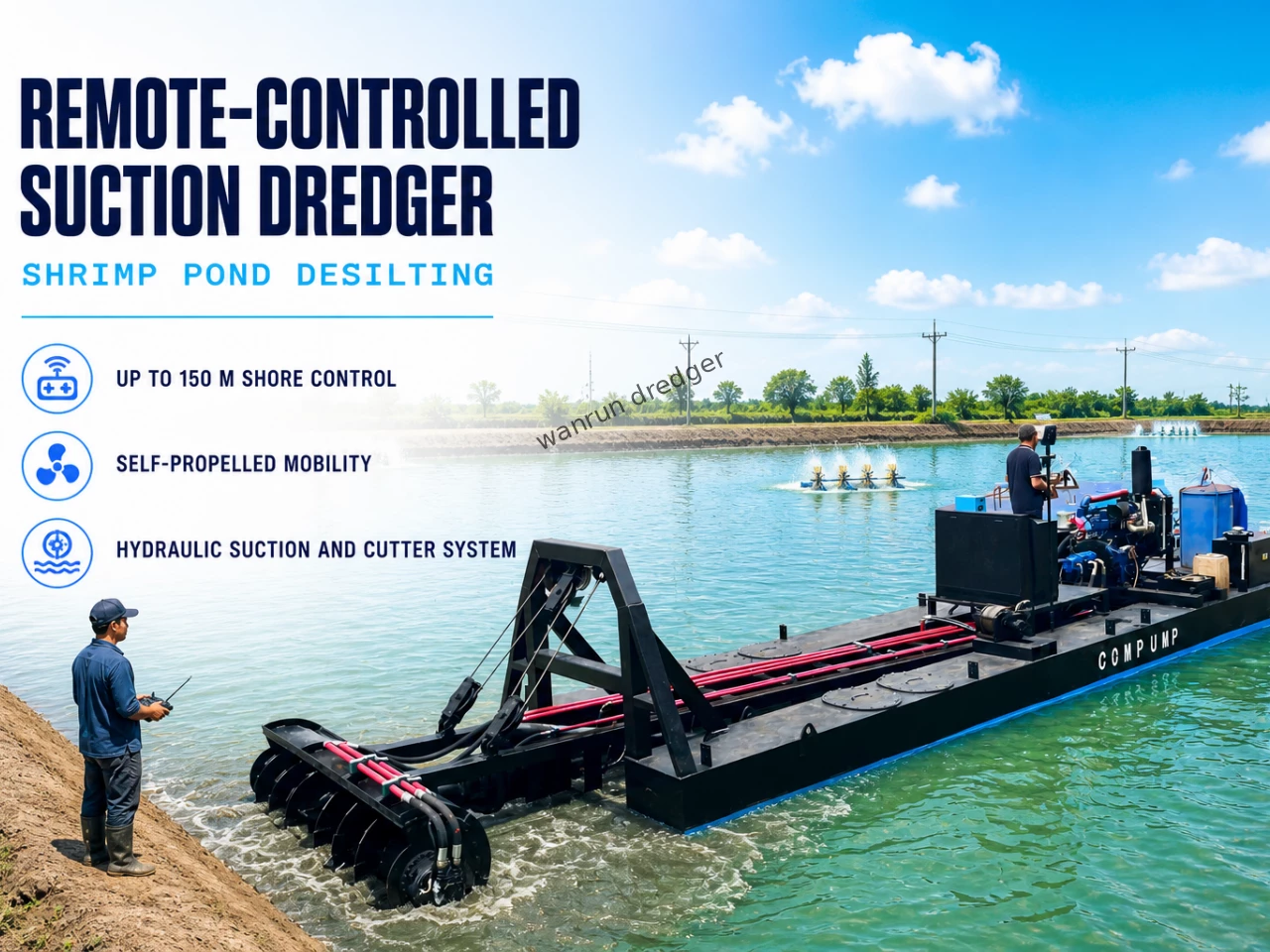
Trailing Suction Dredger Range for Pond, Canal and Waterway Desilting
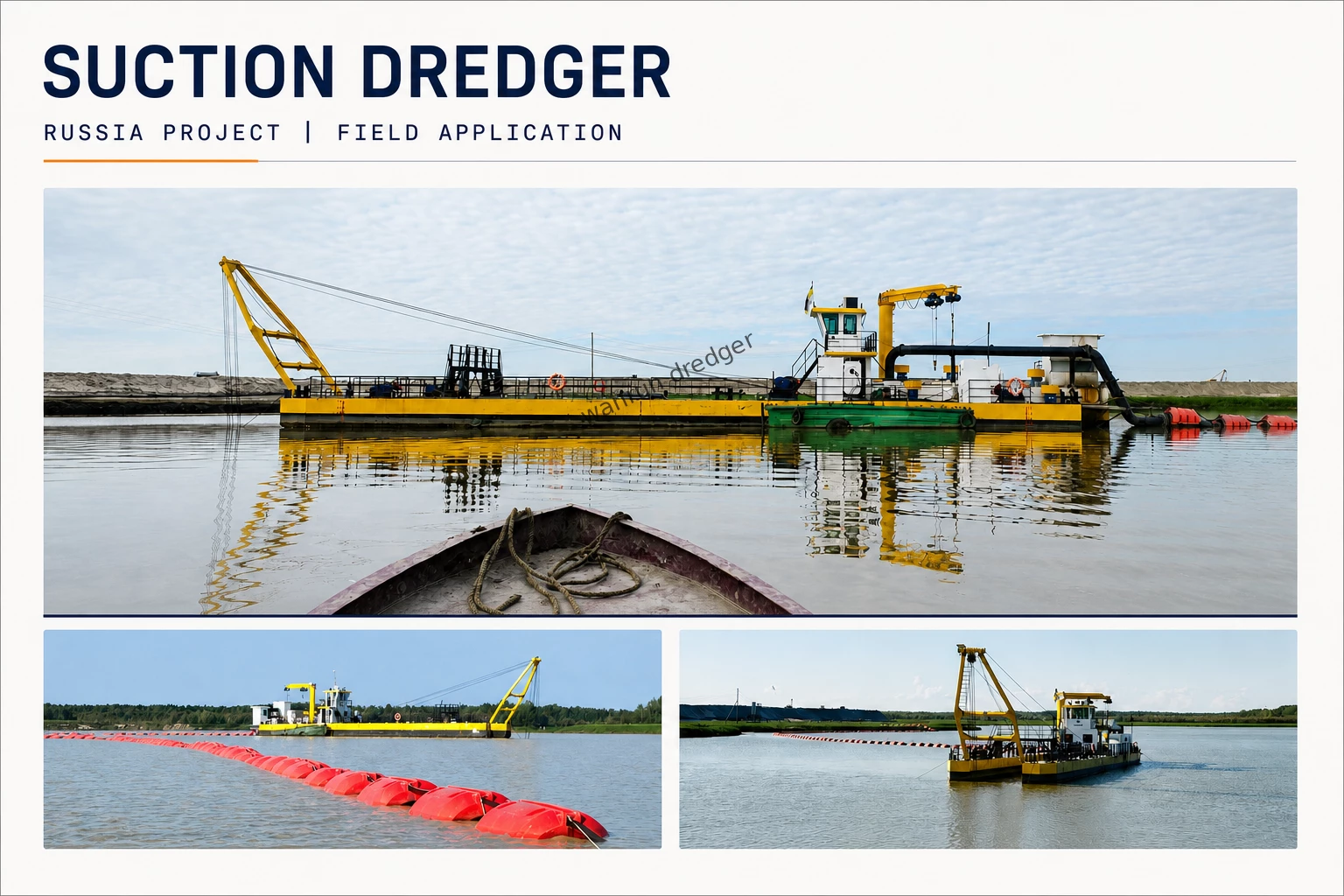
WR-JSD400 Jet Suction Dredger for a Russia Sand Dredging Project
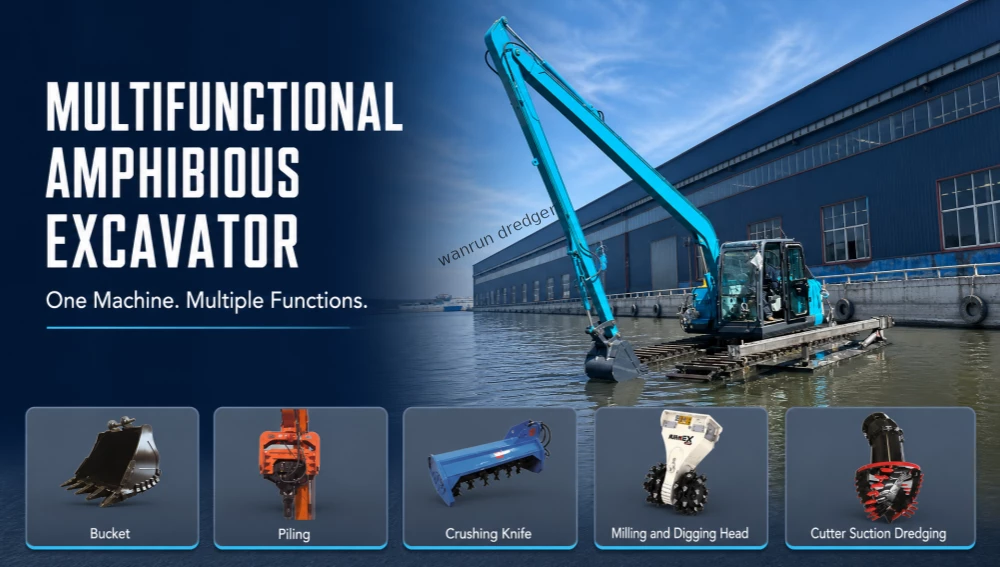
Amphibious Weed Harvester for Lake Vegetation Removal
cutter suction dredger
Need the Full Spec Sheet & Price List?
Our export engineers reply within 24 hours with quotations, shipping options and parts support.