
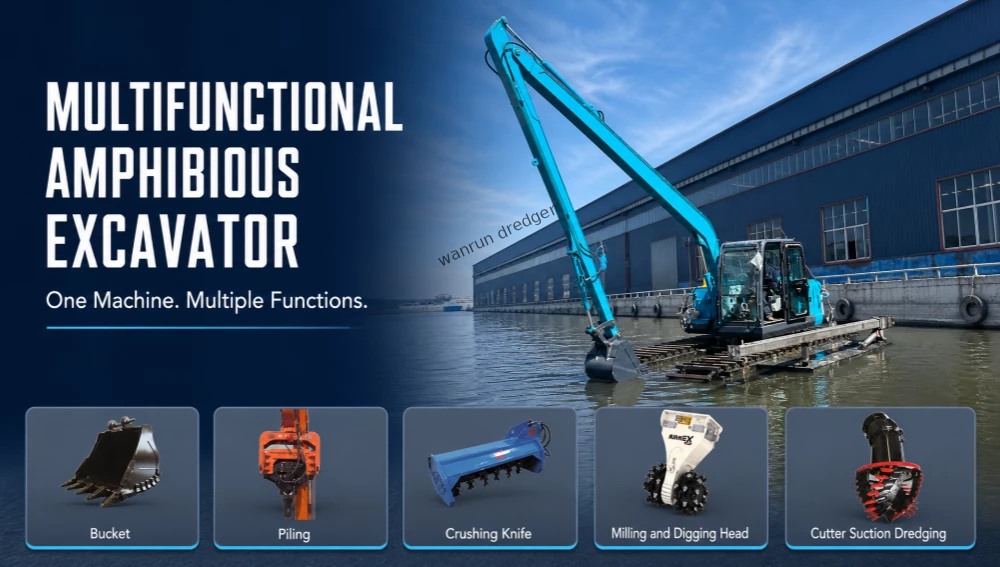
WRWJ-1 Amphibious Excavator Case for Shallow-Water River Dredging
A reference application case based on the verified WRWJ-1 configuration; it does not claim a named customer, location or completed-project result.
Case summary: The WRWJ-1 amphibious excavator combines a pontoon undercarriage, a 0.8 m³ bucket, a 6 m excavating arm and optional dredging attachments for sediment removal in rivers, lakes, canals, marshes and wetlands. Its documented configuration supports mechanical excavation to 4 m and sand-pump dredging to 5 m, with a listed discharge distance of up to 500 m.
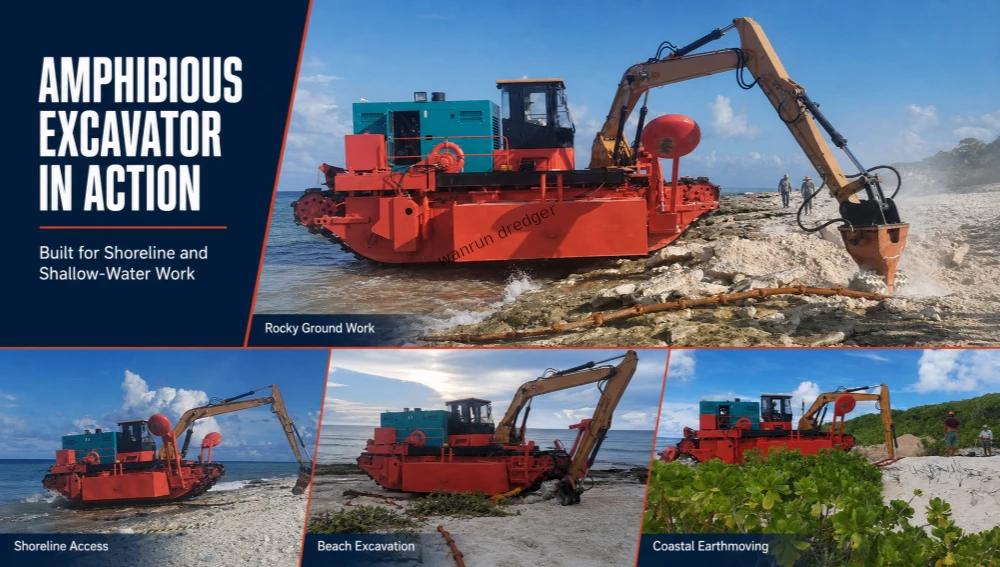
Shallow-water maintenance projects often sit between the capabilities of a conventional excavator and a dedicated dredger. Soft banks can limit ground access, while low water depth may prevent larger vessels from approaching the work zone. An amphibious excavator addresses this access problem by combining excavator functions with a floating pontoon platform designed for wet, soft and partially submerged terrain.
This application case shows how the WRWJ-1 can be configured for river sediment removal, channel maintenance and wetland engineering. The machine can use its bucket for controlled excavation and, where the attachment package is fitted, use a cutter and sand pump to loosen and transfer slurry through a discharge pipeline.
What challenge does the amphibious excavator solve?
The reference job scenario is a shallow river or canal with accumulated silt, restricted bank access and changing water levels. The project needs a machine that can work near the shoreline, stabilize itself during excavation and manage both compacted material and pumpable sediment.
According to the U.S. National Ocean Service, dredging is the removal of accumulated sediment and debris from the bottom of water bodies. In practice, the method must be selected around water depth, sediment characteristics, environmental controls and the planned handling of dredged material. For a shallow-water zone, the WRWJ-1 amphibious excavator provides a flexible platform for excavation, cutter-assisted loosening and slurry pumping without relying on a deep-draft vessel.
How is the WRWJ-1 configured for river dredging?
The machine is built around two side pontoons and an overall reference size of 9 × 3.9 × 3.5 m. An 8 m position-spud system and 4.5 m front support arms are intended to improve working stability in the designated operating area. A 6 m excavating arm carries the bucket or selected attachment, allowing the operator to address sediment around the channel edge and shallow-water work face.
|
System |
Verified reference specification |
Role in the application |
|
Excavation |
0.8 m³ bucket; 6 m excavating arm; 4 m dredging depth |
Mechanical removal, profiling and handling of heavier or less pumpable material |
|
Hydraulic water flow |
400 m³ documented water-flow parameter |
Reference hydraulic-flow specification; confirm the final measurement definition in the technical datasheet |
|
Sand-pump system |
150WN pump; 500 m³/h listed sand-pump flow; 50 m head; 5 m pump dredging depth |
Transfers loosened sediment and water as slurry |
|
Cutter system |
700 mm cutter; 20 kW cutter power; 30–40 rpm |
Breaks and agitates consolidated sediment before pumping |
|
Discharge |
Up to 500 m listed discharge distance |
Moves dredged slurry from the work face to the planned receiving area |
|
Power |
194 kW total/diesel power |
Supports excavation and the documented hydraulic dredging configuration |
|
Stability |
2 side pontoons; 8 m position spuds; 4.5 m front support arms |
Helps establish a stable working position in shallow water and soft terrain |
Configuration check before publishing or quoting: The documented 400 m³ water-flow parameter is separate from and should not be confused with the 500 m³/h sand-pump flow. The source document lists the 150WN sand pump and 700 mm cutter in the WRWJ-1 reference configuration, but it also requires confirmation that these items are included in the complete machine package. If either attachment is optional, label it clearly as optional on the live product page and in the quotation.
Both the cutter head and the dredging bucket are optional items.
How would the dredging workflow be organized?
1. Survey the channel and define the work zone
Measure water depth, sediment thickness, bank condition, access width and the permitted receiving area for dredged material. The project team should also confirm environmental restrictions, pipeline routing and local permits before mobilization.
2. Position and stabilize the amphibious excavator
Move the machine into the planned shallow-water work zone and establish a stable operating position with the pontoons, position spuds and front support arms. Site-specific operating procedures and load limits should govern deployment; the published dimensions and component lengths are selection references rather than substitutes for an engineering plan.
3. Match the attachment to the sediment
Use the 0.8 m³ bucket for controlled digging, bank shaping and material that needs mechanical handling. Where fine sediment can be transported as slurry, the cutter can loosen the bed while the sand pump transfers the mixture. This dual-method approach lets one amphibious excavator adapt to different sections of the same project.
4. Manage discharge and placement
The documented system lists a 500 m discharge distance, 500 m³/h sand-pump flow and 50 m head. Actual output will vary with sediment concentration, particle size, pipeline diameter and length, bends, elevation change, wear condition and operator setup. A pump calculation and site test should therefore be completed before confirming production targets.
5. Verify the finished profile
After each work section, survey the channel profile and check that sediment removal matches the approved design. Records should cover operating hours, material type, discharge location and any environmental controls applied during dredging.
Why use an amphibious excavator instead of a standard excavator?
|
Selection factor |
WRWJ-1 amphibious excavator |
Conventional land excavator |
|
Soft-ground access |
Pontoon configuration is designed for wet and soft operating environments |
May require a prepared access road, mats or bank-only positioning |
|
Shallow-water reach |
Can be positioned in suitable shallow-water work zones |
Usually limited by shoreline reach and bank stability |
|
Work methods |
Bucket excavation plus documented cutter-and-pump configuration |
Primarily mechanical excavation unless separately modified |
|
Material transfer |
Listed pump system supports pipeline discharge up to 500 m |
Often relies on trucks, barges or additional transfer equipment |
|
Best-fit projects |
Rivers, canals, lakes, marshes, wetlands and tidal flats |
Dry or reliably prepared ground with stable access |
The comparison is not a claim that one machine replaces every dredger or excavator. The best choice depends on geotechnical conditions, water depth, sediment properties, environmental requirements and target production. The value of an amphibious excavator is its ability to bridge excavation and dredging tasks in work zones where access is the main constraint.
Where can this amphibious dredger configuration be applied?
- River and canal maintenance:remove deposited silt and restore the designed flow section.
- Lake desilting:excavate or pump sediment from accessible shallow-water zones.
- Wetland restoration:support controlled earthworks, channel creation and sediment management under an approved restoration plan.
- Marsh and tidal-flat engineering:reach soft areas where conventional crawler access is difficult.
- Water-conservancy projects:maintain drainage channels, reservoirs and shoreline infrastructure.
The U.S. Environmental Protection Agency notes that dredged sediment can have beneficial uses, including wetland restoration, when material quality, engineering design and regulatory requirements are properly addressed. This reinforces the need to plan sediment testing, transport and placement as part of the project—not only the excavation step.
What should buyers confirm before selecting the WRWJ-1?
- Operating environment:minimum and maximum water depth, soft-ground condition, current and wave exposure.
- Sediment profile:silt, sand, clay, organic matter, debris and expected particle size.
- Production target:required hourly or daily output under defined site conditions.
- Discharge route:total pipeline length, elevation, bends and receiving-area restrictions.
- Attachment package:confirm whether the 150WN sand pump, 700 mm cutter, pipelines and supporting hydraulic components are included.
- Transport and assembly:verify module dimensions, transport method, lifting plan and local access.
- Compliance:check local permits, environmental controls, operator requirements and safe working procedures.
Frequently asked questions
What is an amphibious excavator used for?
An amphibious excavator is used for shallow-water, wetland, marsh, tidal-flat and soft-ground projects where a conventional excavator has limited access. Common tasks include sediment removal, river dredging, canal maintenance, shoreline work and wetland restoration.
What is the working depth of the WRWJ-1?
The verified source configuration lists a 4 m dredging depth for excavation and a 5 m sand-pump dredging depth. Final capability depends on attachment setup, site conditions and the approved operating plan.
Can the machine excavate and pump sediment?
Yes, the documented configuration combines a 0.8 m³ bucket with a 150WN sand pump rated at 500 m³/h and a 700 mm cutter. Confirm whether the cutter-and-pump package is standard or optional before publishing commercial claims.
How far can it discharge dredged material?
The reference specification lists a discharge distance of up to 500 m and a pump head of 50 m. Actual performance depends on slurry properties, pipe layout, elevation and operating conditions.
Is the WRWJ-1 suitable for wetland restoration?
It can support wetland earthworks and sediment-management tasks where its operating envelope fits the site. The project must still follow local ecological, water-quality and permitting requirements.
What information is needed for a technical proposal?
Provide the project location, water depth, sediment type, target dredging depth, daily production goal, discharge distance, elevation change, access limits and required attachments. These inputs allow the engineering team to check configuration suitability.
Request a project-specific amphibious excavator configuration
Send your water depth, sediment type, target dredging depth, required discharge distance and expected production. Our engineering team can use these conditions to review whether the WRWJ-1 bucket, cutter and sand-pump configuration fits your river, lake, canal or wetland project.