
Multifunctional Amphibious Dredger | Wanrun Water King WR-1
Wanrun WR-1 multifunctional amphibious dredger: pontoon hull, 180° boom, reamer head, bucket and 150 mm pump discharge. Request a proposal.
- CE & EPA Certified
- 18-Month Warranty
- Global Parts Warehouses
Multifunctional Amphibious Dredger
WR-1 (500 m³) | Pontoon Dredger with 180° Hydraulic Boom, Reamer Head and Interchangeable Attachments
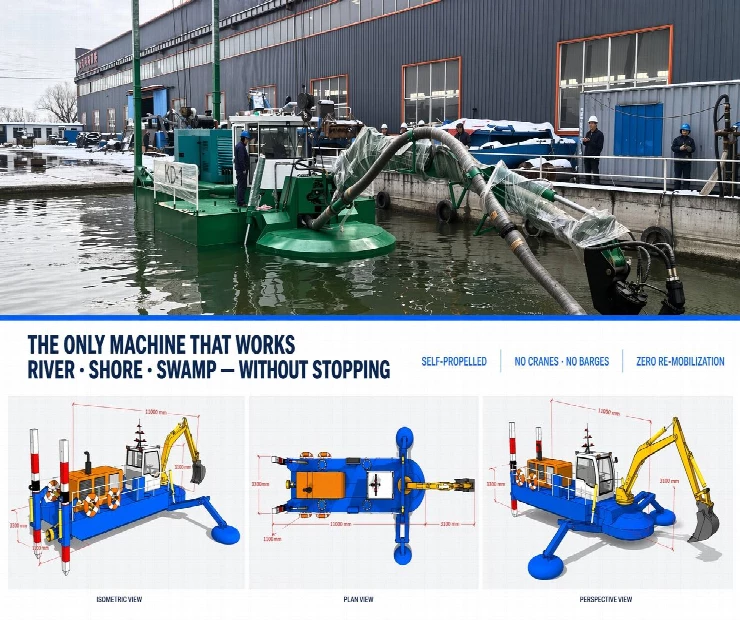
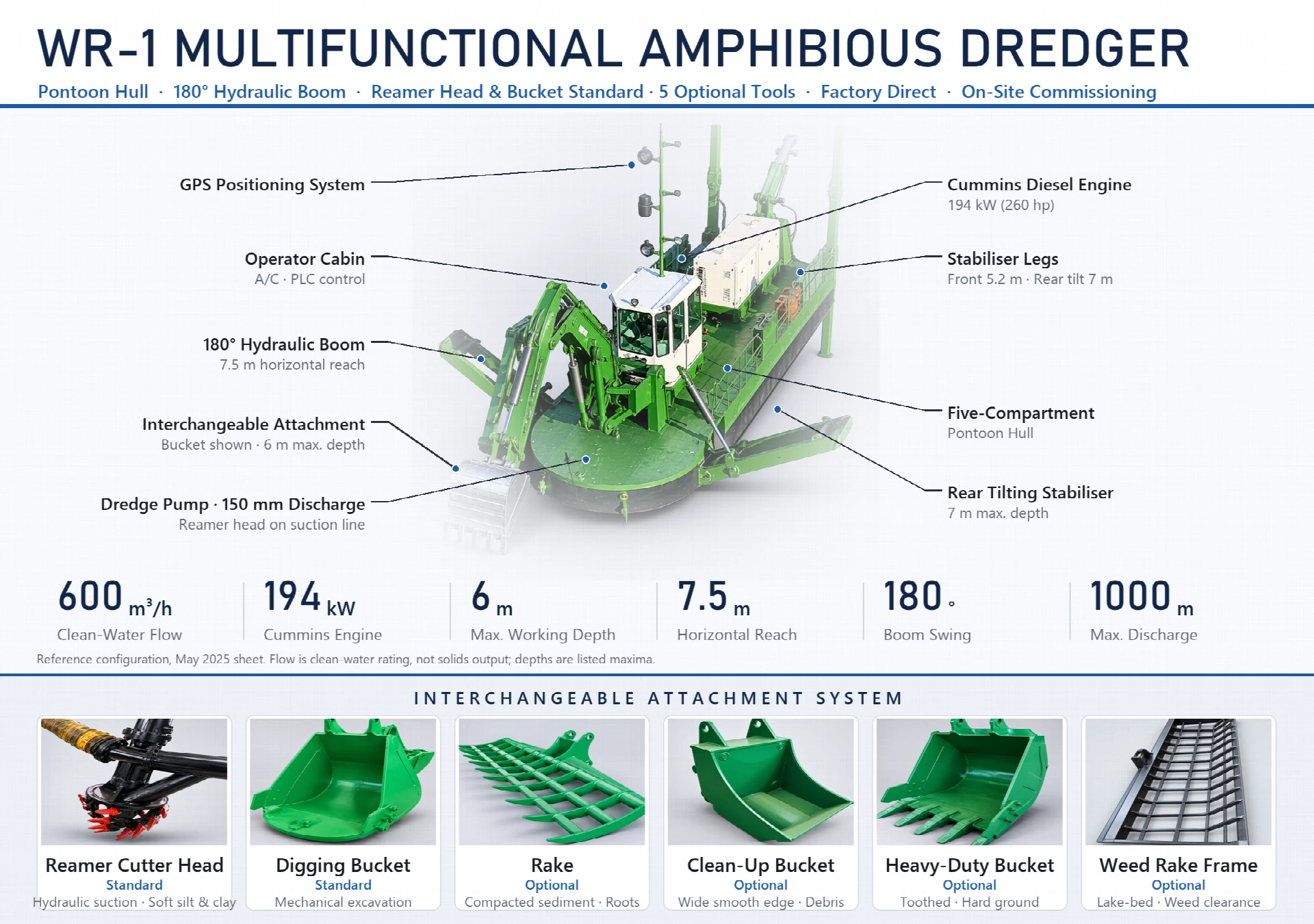
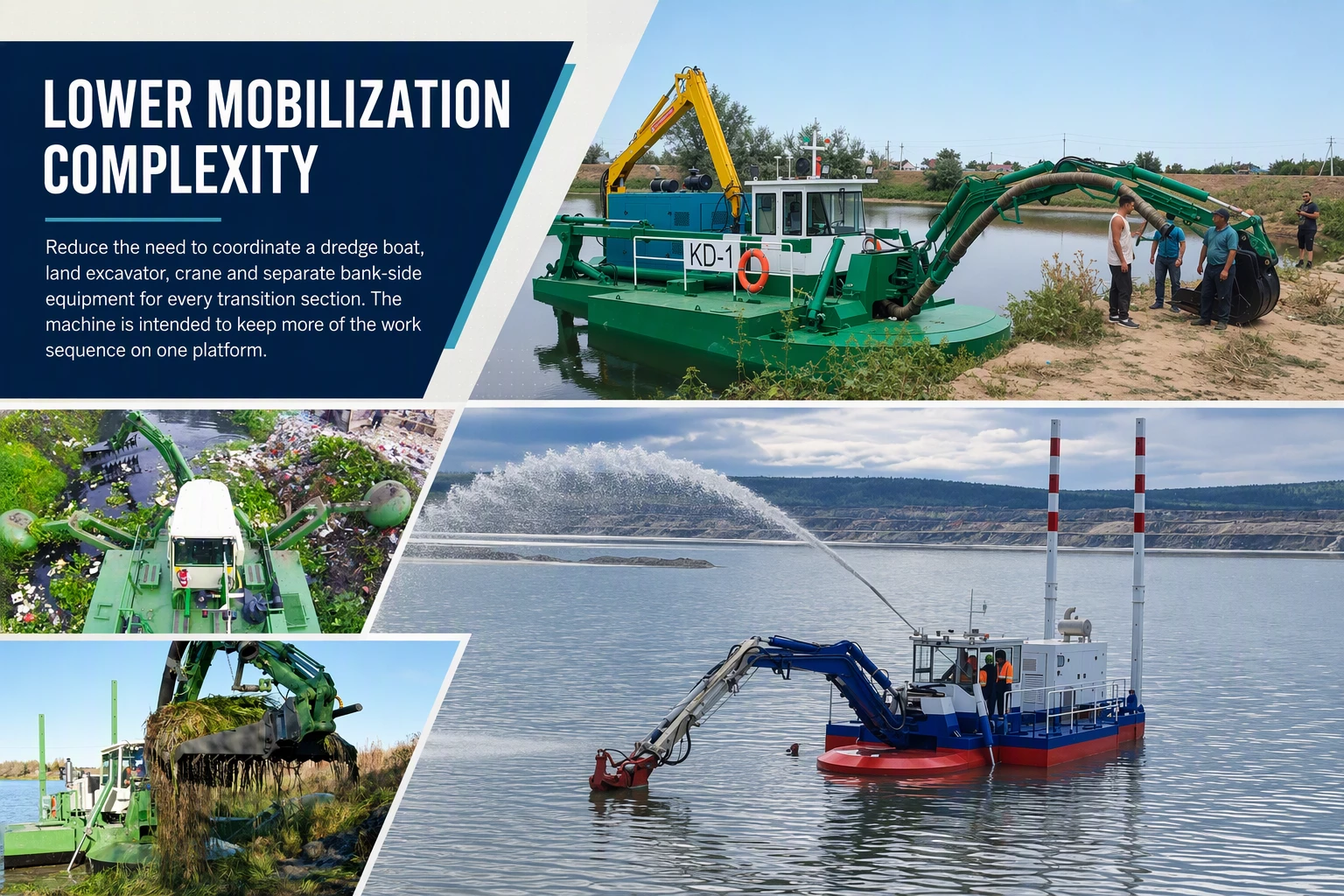
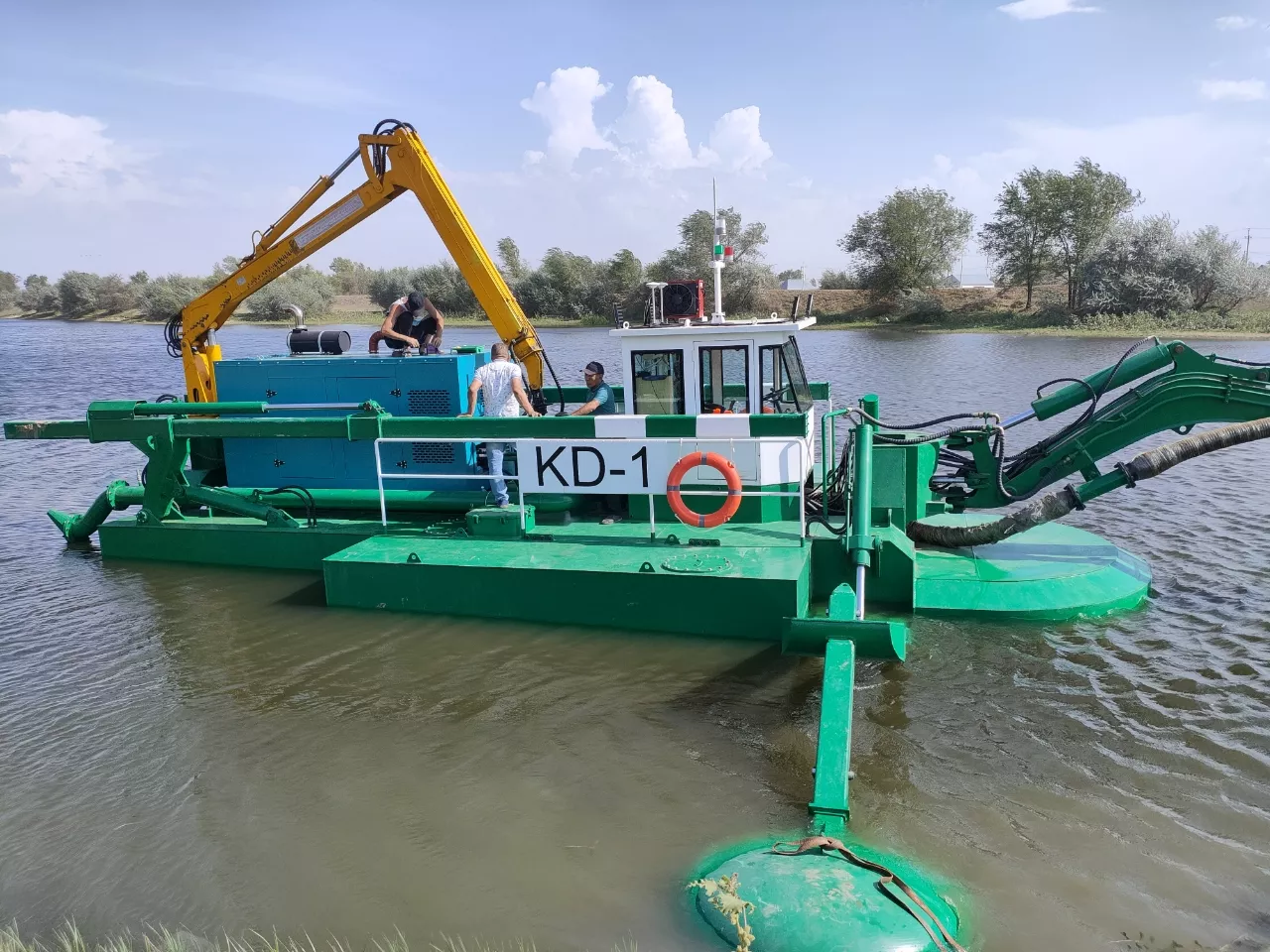
The WR-1 multifunctional amphibious dredger from Shandong Wanrun Intelligent Equipment Co., Ltd. puts two working systems on one five-compartment pontoon hull. A reamer head on the suction line and a dredge pump move loosened material through a 150 mm discharge line; a separate 180°-swing hydraulic excavator boom carries a digging bucket for mechanical excavation, debris clearing and handling work. Five further end-effectors — rake, clamshell grab, pile-driving attachment, wood clamp and milling head — are listed as options, so one hull can cover several dredging and waterfront-maintenance tasks without a second vessel.
The reference configuration is aimed at shallow-water and bank-line work: listed maximum working depth of 6 m for both reamer head and bucket, 7.5 m horizontal digging distance, stabiliser legs rated to 5.2 m (front) and 7 m (rear tilt), 4-knot self-propulsion and a GPS positioning system. Transport weight is 20 t at 11.8 m transport length.
Match the WR-1 to Your Dredging Task
- Two work systems on one hull: the dredge-pump path (reamer head + 150 mm discharge) handles pumpable sand and slurry, while the hydraulic boom path (bucket, grab, rake) handles material that is better dug and placed than pumped.
- Seven listed tool formats: reamer head and digging bucket are standard; rake, clamshell grab, pile-driving attachment (vertical pile), wood clamp and milling head are each listed as one-unit options. Attachment changes are hydraulic work on the boom and should be planned with the machine stopped and de-energised.
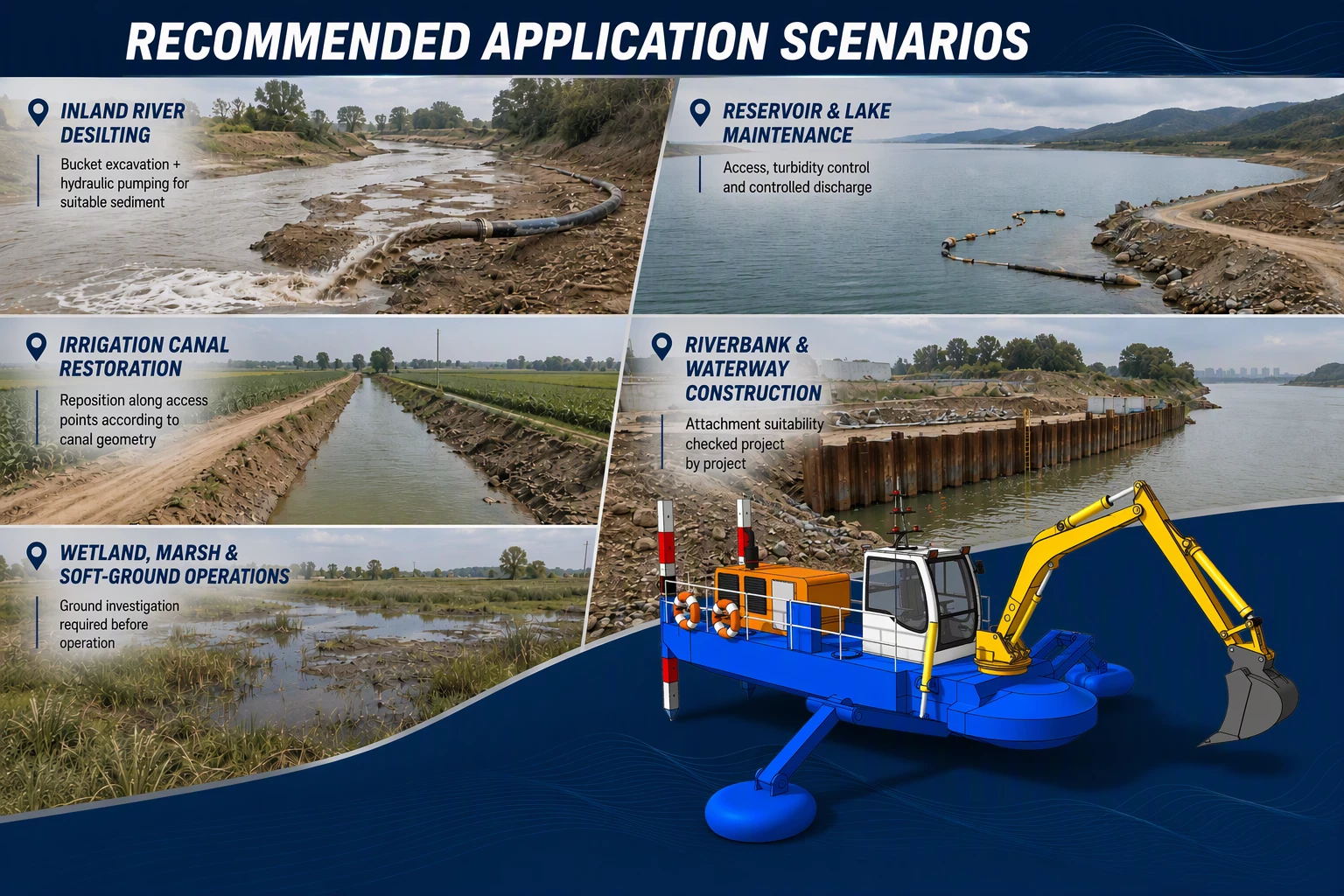
- Reach designed for the water line: a 7.5 m horizontal digging distance with 180° swing and 6 m listed maximum depth for both reamer head and bucket suits bank protection, intake cleaning, pond de-silting and dock aprons — the zone where both banks and open water have to be covered from one position.
- Positioning by legs, not anchors: a front stabiliser to 5.2 m and a rear tilting stabiliser to 7 m hold the hull while the boom works, and a GPS positioning system supports station keeping.
- Pump duty as listed: 150 mm discharge diameter, 6 m working depth, up to 1,000 m discharge distance and 600 m³/h clean-water flow.
- Built to be shipped and re-positioned: 20 t transport weight, 11.8 m transport length (16 m with the arms extended), 3.0 × 3.1 m transport cross-section, listed for one 40 ft high-cube container plus one flat rack. 4-knot self-propulsion covers movement between adjacent working positions on the same water body.
Understand How the Two Working Systems Operate
Pump path. The reamer head works the material at the suction mouth while the dredge pump creates the flow that entrains it and carries the water–solids mixture through the 150 mm discharge line towards the placement area. This is the arrangement industry references describe for suction dredgers: the vessel stays stationary while dredging, discharge goes through a pipeline, and loosening is assisted at the intake rather than by a large rotating cutter. The WR-1 reamer head is a small crown-type tool on the suction end; it is not a cutter suction dredger head.
Boom path. The 180°-swing excavator boom follows the backhoe-dredger principle: a hydraulic excavator on a pontoon with a rotating table, digging back towards the hull and lifting material out of the water instead of pumping it. That suits clay, gravel, cobbles, root mat and debris where a suction path loses efficiency, and it is also what makes the optional grab, rake, wood clamp and pile-driving attachment usable on the same amphibious dredger.
Review the Reference Specifications
|
Parameter |
Reference value |
|
Model |
WR-1 — 500 m³ reference configuration designation |
|
Equipment type |
Multifunctional amphibious dredger: pontoon hull with dredge pump and 180° hydraulic excavator boom |
|
Overall dimensions |
11.0 × 3.3 × 3.1 m (L × W × H) |
|
Floating body (hull) dimensions |
11.0 × 3.3 × 1.1 m |
|
Transport length |
11.8 m |
|
Transport length with arms extended |
16 m |
|
Transport width × height |
3.0 × 3.1 m |
|
Transport weight |
20 t |
|
Diesel engine |
Cummins (engine model not stated on the sheet), turbocharged and intercooled |
|
Engine power / speed |
194 kW (260 hp) at 2,200 rpm |
|
Emission standard, as listed |
Euro III |
|
Electrical system |
24 V |
Performance qualification: 600 m³/h is clean-water flow, not dry-solids output, and the "500 m³" in the configuration designation is not a production rate either.
Check Whether This Configuration Fits Your Site
Consider the WR-1 for projects where dredging, clearing and light handling all have to be done by one small crew on a shallow water body: pond and reservoir de-silting, irrigation canal and intake cleaning, lake and landscaped-water maintenance, port basins and dock aprons, aquaculture pond repair, and bank or shoreline work where debris has to be lifted as well as sediment moved. Because 6 m is the listed depth limit for both working tools, deeper channels, long-distance pumping duties and hard-rock breaking belong in a different equipment class and should be assessed separately.
Send the material description and grading (sand, silt, clay, gravel, root mat, rubble), water depth and required dredge depth, the reach you need from one position, the discharge route and distance, site power and fuel access, the country and inland transport route, and the attachment list you want. We then confirm the equipment scope, attachment set and operating assumptions for your project before any quotation.
Frequently Asked Questions
Is 600 m³/h the sand production rate?
No. 600 m³/h is the pump's clean-water flow. The "500 m³" in the configuration name is a designation, not a rated capacity.
Which attachments are included and which are extra?
The reamer head and digging bucket are standard. Rake, clamshell grab, pile-driving attachment, wood clamp and milling head are each listed as one-unit options, fixed before production.
Can the milling head break rock or concrete?
A milling head is listed as an option, but the sheet gives no rock strength or milling productivity. Send a ground description; hard-rock duty needs an engineering review before the attachment is confirmed.
Can it pump and dig at the same time?
The sheet describes the pump path and the boom path separately and gives no combined-duty figure, so they are treated as separate operating modes until a project duty sheet is agreed.
How is the machine held in position?
A front stabiliser (5.2 m listed maximum depth) and a rear tilting stabiliser (7 m) carry the working loads, with the GPS positioning system for station keeping. No anchor winch or spud carriage is listed.
What powers the WR-1 multifunctional dredger?
A Cummins diesel engine rated 194 kW (260 hp) at 2,200 rpm drives an imported Rexroth-series hydraulic system at 25 MPa, on a 24 V electrical system, listed to Euro III.
What about installation, training and after-sales response?
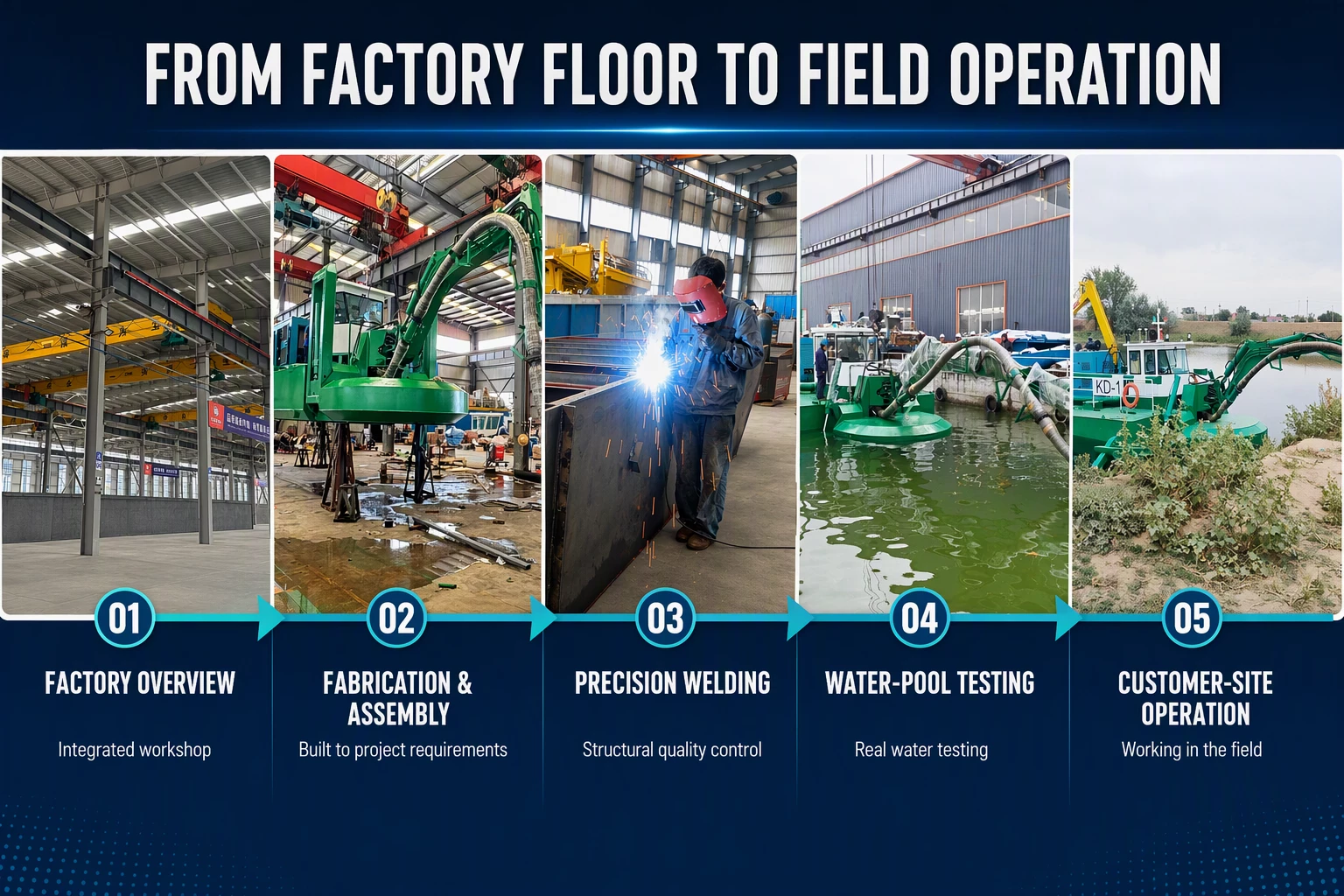
The configuration sheet states that requirements are confirmed before contract, with site planning, installation and commissioning support, targeted operator training, an initial reply within 1 hour of a reported problem and a proposed solution within 24 hours.
What should I send when requesting a WR-1 proposal?
The list above: material and grading, depths, required reach, discharge route, site power, country and inland transport route, and the attachment set you want.
Request a Dredging Proposal
Discuss your multifunctional amphibious dredger requirements with Shandong Wanrun Intelligent Equipment Co., Ltd. Send the site information above to request a configuration review, attachment selection and project-specific quotation for the WR-1.
Request a Dredging Proposal
Waterway & Port Maintenance
Channel, berth and basin dredging
Sand & Aggregate Mining
River, lake and nearshore sand extraction
Land Reclamation
Hydraulic fill for coastal and site works
Aquatic Plant & River Cleanup
Water hyacinth, reed and debris harvesting
Related Products
More proven machines from the WanRun mining & construction lineup
Need the Full Spec Sheet & Price List?
Our export engineers reply within 24 hours with quotations, shipping options and parts support.