
Water Hyacinth Harvesting Vessel: How to Choose the Right Machine for Large-Scale Weed Removal
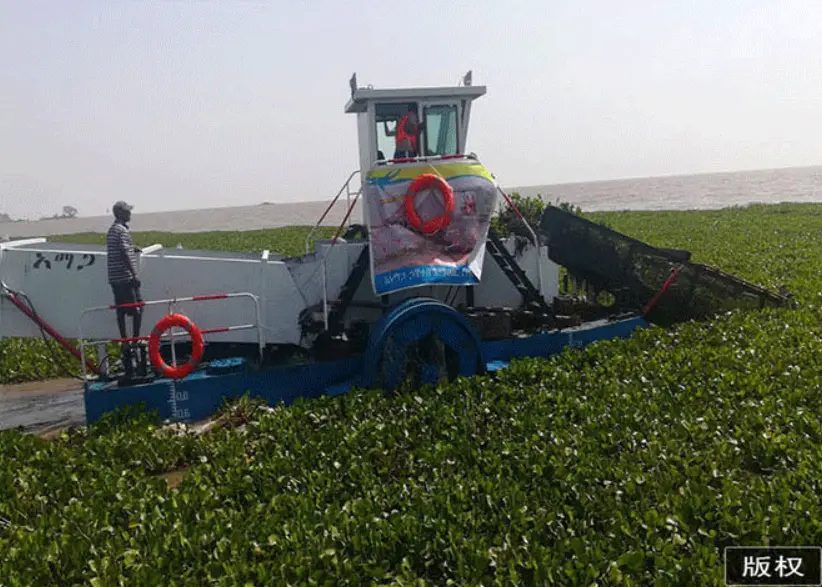
Why Water Hyacinth Is One of the World's Worst Aquatic Weeds
Water hyacinth (Eichhornia crassipes) is a free-floating plant native to South America that has invaded warm waterways on every continent. It reproduces mainly through daughter plants, and under favorable conditions a floating mat can double its area in a matter of days. The consequences are severe:
- Clogged waterways. Dense, interlocked mats make boating, fishing and ferry services impossible, and can block entire river reaches and harbor entrances.
- Oxygen collapse. Mats block the air-water interface and shade the water below. As plants decay, dissolved oxygen drops sharply, causing fish kills and eliminating native vegetation.
- Flood and infrastructure risk. Floating islands pile up against bridges, sluice gates, hydropower intakes and irrigation pumps, reducing capacity and damaging equipment.
- Public health impact. Still, plant-choked waters provide breeding habitat for mosquitoes and complicate drinking water supply management.
Herbicides and biocontrol agents can suppress the weed, but for navigation channels, drinking water reservoirs and urban waterways, mechanical removal with a water hyacinth collection vessel is often the only acceptable short-term answer.
How a Water Hyacinth Harvesting Vessel Works
A water hyacinth harvester is a reinforced aquatic weed harvester designed for thick floating mats. The process runs in four stages:
1. Gathering and cutting
The vessel approaches the mat, and hydraulically driven scissor knives or reciprocating cutter bars slice the plants at or below the water surface. Gathering arms and the shape of the bow funnel the floating mass toward the cutter, so the machine works continuously without stopping to push plants together.
2. Collecting and dewatering
A front conveyor — usually a heavy-duty chain or mesh belt — lifts the cut hyacinth out of the water and passes it to a middle conveyor. Water drains through the belt as the load climbs, so the vessel carries plants, not water.
3. Shredding and volume reduction
On a water hyacinth shredding vessel, the harvested material passes through an onboard shredder before storage. Shredding cuts the bulk of the load dramatically, extending the time between discharges and making transport to shore cheaper. Some configurations add a baler or press for even denser loads.
4. Storage and discharge
The processed material is stored in the hold or on a rear conveyor. When full, the vessel sails to shore or alongside a barge and discharges via an elevated conveyor directly into dump trucks. A single water hyacinth harvesting machine can remove hundreds of cubic meters of mat per day — biomass that would otherwise take dozens of workers with rakes and small boats to clear.
Where These Vessels Are Used
- Rivers and canals where mats block navigation and flood discharge.
- Lakes and reservoirs that supply drinking water or support tourism.
- Hydropower forebays and pump stations where floating weeds threaten screens and turbines.
- Urban ponds and park lakes during seasonal blooms.
- Coastal cleanup. Similar hulls are deployed as a Sargassum harvesting vessel to collect seaweed rafts before they reach beaches and resorts.
- Amphibious weed control. The same collection concept applies to an Alligator weed collection vessel, because alligator weed forms floating mats along banks and in shallow zones.
Key Specifications to Compare
- Working width: typically 2–4 m on dedicated hyacinth vessels; wider heads clear mats faster but require more turning space.
- Cutting and collection depth: usually adjustable around 0.5–1.5 m, enough for floating mats and the upper layer of rooted weeds.
- Draft: check both light and loaded draft; many hyacinth jobs happen in shallow, eutrophic waters less than 1.5 m deep.
- Collection capacity: compare theoretical capacity in m³/h or tons per day, and hold volume — hyacinth is bulky, so storage often limits productivity more than cutting speed.
- Engine power: mid-size vessels commonly use diesel engines around 50–150 kW driving hydraulic pumps for propulsion, cutters and conveyors.
- Shredder option: decide whether onboard shredding or baling pays off, based on your transport distance and disposal route.
- Discharge height and reach: the conveyor must match your trucks, barges or quay walls.
Operation and Maintenance Best Practices
- Sharpen or replace cutter blades frequently; hyacinth mats often carry sand and debris that accelerate blade wear.
- Clean conveyors daily — tangled roots and plastic waste wrapped around rollers are the most common cause of downtime.
- Check hydraulic hoses, fittings and oil condition on schedule; the hydraulic system drives nearly every function on board.
- Plan disposal in advance: shredded hyacinth can be composted, used as mulch or landfilled, but you need a dewatering area and transport ready before the harvest season.
- Respond early. Small mats harvested within weeks cost a fraction of the effort needed for mature mats that have colonized an entire lake.
- Combine harvesting with nutrient-load reduction at the source; otherwise the weed will return every season.
Integrating Harvesting into a Long-Term Strategy
Mechanical harvesting is the emergency response tool, but it works best inside a wider program: controlling fertilizer and wastewater inputs, monitoring early colonization with surveys, and scheduling repeat harvests before mats set seed. Because every harvested ton exports nitrogen and phosphorus from the waterbody, a well-run water hyacinth harvesting vessel fleet gradually weakens the weed's advantage year after year.
A Long-Term Partner for Weed Control Fleets
If you manage several water bodies, you may need more than one type of vessel — a fast harvester for open water, a shallow-draft unit for ponds, and dredgers for silt. Shandong WanRun Intelligent Equipment Co., Ltd., based in the Mizhou Town Industrial Park, Qingzhou, Shandong, supplies 104 products in 10+ series, covering cutter suction dredgers from 6 to 24 inch, trailing suction dredgers, the Water King amphibious dredger with around 500 m³/h capacity and diesel-electric operation, the Type 70 amphibious excavator, and water surface cleaning equipment.