
Trailing Suction Hopper Dredger: How Hopper Dredging Works and When to Choose It
What Is a Trailing Suction Hopper Dredger?
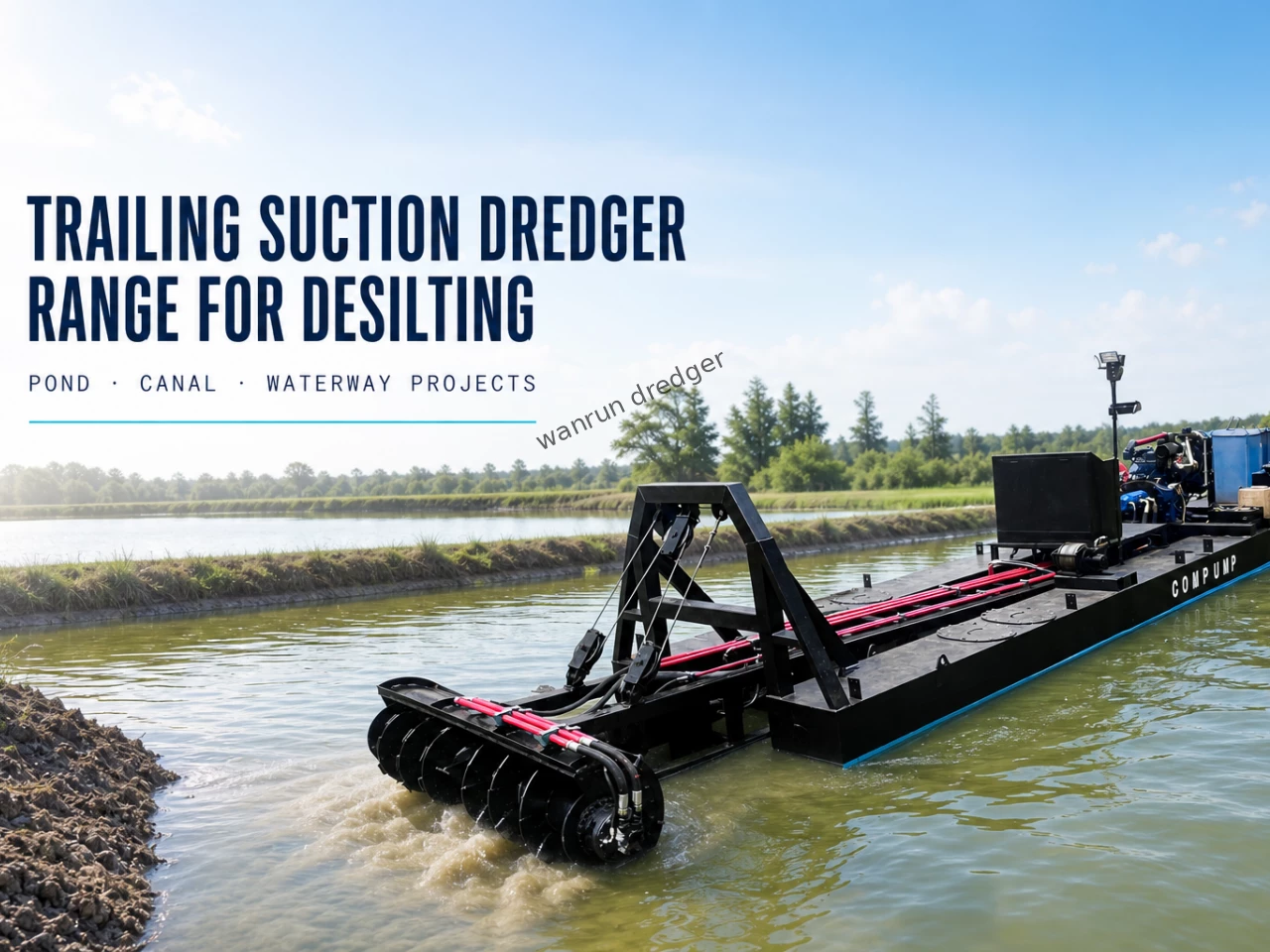
A trailing suction hopper dredger (TSHD) is a self-propelled dredging vessel that excavates material by trailing one or two drag heads along the seabed while sailing slowly over the work area. The drag heads ride on articulated suction pipes, and onboard dredge pumps lift the sand-water mixture into an integrated hopper inside the hull. When the hopper is full, the vessel sails to the disposal site and unloads itself. In everyday industry language you will also hear it called a hopper suction dredger, and the method itself is known as hopper dredging.
This combination — excavation, transport, and discharge in a single vessel — is what makes the TSHD the flagship of marine dredging equipment fleets worldwide.
How the Hopper Dredging Cycle Works
- Lowering. The suction pipes swing down until the drag heads touch the seabed at the target depth.
- Loading. Sailing slowly, the ship drags the heads across the bottom while dredge pumps lift the slurry into the hopper. Excess water spills over the overflow weir so the load settles and concentrates.
- Sailing. Once the hopper reaches its target load, the pipes are raised and the vessel transits to the disposal area under its own power.
- Discharging. Depending on the project, the load is released through bottom doors, rainbowed over the side by pump, or pumped ashore through a floating pipeline — sometimes assisted by an underwater pump and jet system that fluidizes the material.
Where Trailing Suction Hopper Dredgers Are Used
- Maintenance dredging of busy channels and ports. Because a TSHD works while underway and carries its own spoil, shipping traffic can continue around it — the reason major estuary and river maintenance programs run on TSHDs year-round.
- Deepening of approach channels and berths in sand, silt, and soft clay.
- Beach nourishment, pumping sand from offshore borrow areas onto the coast.
- Land reclamation, where the hopper load is pumped into polders or containment areas.
- Marine sand winning for construction aggregate.
Key Specifications to Compare
When evaluating a trailing suction hopper dredger, these parameters drive productivity and price. Values below are typical industry ranges.
Hopper capacity
Hopper volume defines how much material moves per cycle. Small and medium units run from a few hundred to about 5,000 m³; large coastal and offshore vessels reach 10,000–30,000 m³ and beyond. Choose capacity together with transport distance: a bigger hopper pays off on long sails, while short cycles favor agility over volume.
Dredging depth
Typical working depths are 15–35 m, with deep-dredging specifications of 45 m or more on large vessels. Note that depth ratings can differ between the port and starboard suction pipes, so check each arm separately.
Suction pipe diameter and pump power
Pipe diameters commonly range from about 700 mm on smaller ships to 1,200–1,400 mm on large ones. Larger pipes move more solids but need more pump power and more draft.
Discharge system
Bottom doors suit dumping at sea; a rainbow or shore-pumping setup is needed for nourishment and reclamation. Confirm which configurations the vessel supports before ordering.
Free-sailing speed and draft
Transit speeds between roughly 10 and 15 knots are typical for modern TSHDs; loaded draft determines which ports and channels the ship can enter between cycles.
TSHD vs. Cutter Suction Dredger: Where Each Fits
The two types complement rather than replace each other. A TSHD handles loose, free-flowing sand, silt, and light sediment, moves itself between sites, and keeps busy channels open — but it cannot cut consolidated clay or rock. A cutter suction dredger is stationary, excels in harder soils and precise profiles, and pumps continuously to shore, yet it needs anchors and cannot sail between sites on its own. Many large projects deploy both: a CSD to cut and a TSHD to transport.
Maintenance Checklist for Hopper Dredgers
- Drag heads and suction pipe wear parts — inspect after every campaign; drag head teeth and lips are consumables.
- Hopper doors, hinges, and rubber seals — leakage erodes seals quickly and wastes load.
- Dredge pump impellers, liners, and glands — keep spares stocked, because slurry abrasion is continuous.
- Winches, wires, trunnions, and pipe-lifting systems — load-bearing items that deserve scheduled non-destructive inspection.
- Hull and hopper corrosion protection — coatings and sacrificial anodes, especially in salt water.
Final Thoughts
If your project involves loose sediment, long transport distances, or a channel that must stay open to traffic, a trailing suction hopper dredger is usually the most productive marine dredging equipment you can deploy. Shandong WanRun Intelligent Equipment Co., Ltd. offers hopper dredger solutions including an electric remote-controlled model with roughly 10 m dredging depth and about 100 m³/h capacity — three units of which were delivered to Thailand — alongside a full range of cutter suction and amphibious dredgers. With 104 models in 10+ series, 100+ customized projects, a repeat purchase rate around 90%, and after-sales consulting 360 days a year, WanRun can help you size the right suction dredger.