
Multifunctional Amphibious Dredger: A Buyer's Guide to Crawler Dredgers for Shallow Water
What Is an Amphibious Dredger?
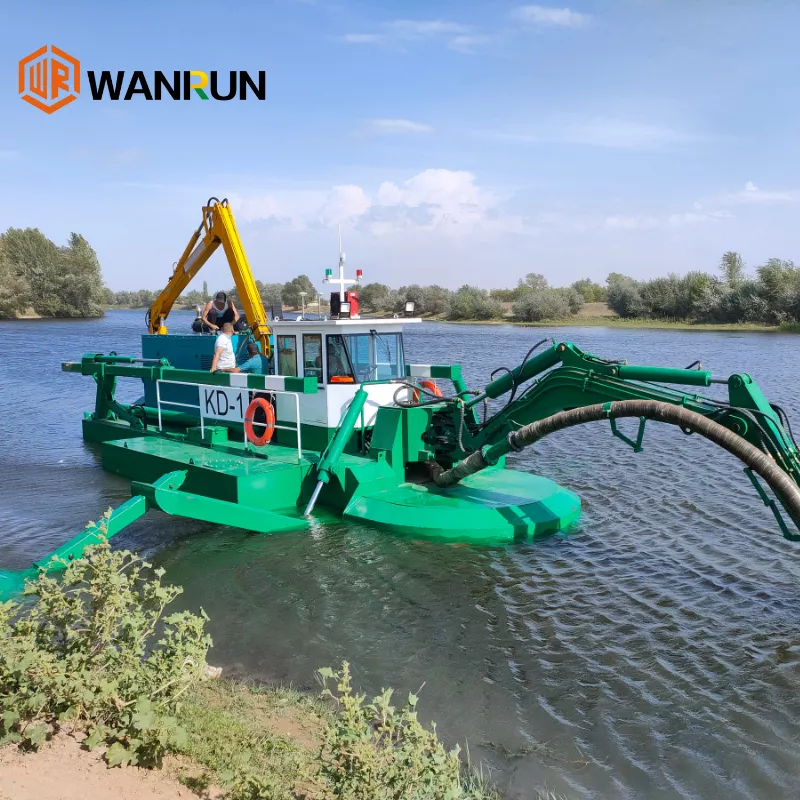
A crawler amphibious dredger combines three elements into one machine: a tracked crawler undercarriage, sealed flotation pontoons, and an excavator-style work arm with interchangeable attachments. It drives itself into and out of the water without a crane, crawls along soft banks and wetlands, and floats with its own propulsion in open water. Depending on the region and the attachment fitted, people also call it an amphibious excavator, a crawler excavator dredger, or — after one well-known American brand — a mudcat dredge.
How a Crawler Amphibious Dredger Works
- Undercarriage. Heavy-duty crawler tracks, often with grousers, provide traction on mud, sand, and slopes that would stop a wheeled machine.
- Flotation. Sealed steel pontoons keep the machine afloat and stable, typically working in water from about 0.3 m upward depending on the model.
- Positioning. Spuds or spud carriers anchor the machine while it works, giving the precision of a stationary dredge.
- Attachments. The same carrier can mount a cutter suction head with a dredge pump, a backhoe bucket, a grab, a weed rake, a grapple, or a pile driver — the essence of a multifunctional amphibious dredger.
Power is usually diesel-hydraulic, with diesel-electric and fully electric options appearing on newer models for lower emissions and quieter operation in urban waterways. Propulsion in open water comes from hydraulic motors on the tracks, from propellers or water jets, or from a combination of both, so the machine can reposition itself without any support boat.
Typical Applications
- Lake and pond restoration. Working as a lake dredger, it removes nutrient-rich silt, restores depth, and reshapes shorelines without draining the water body.
- Waterway cleaning and maintenance. As waterway cleaning equipment, it clears sediment, rubbish, weeds, and sunken debris from canals, drainage channels, and floodways.
- Wetland and marsh restoration, where ground pressure must stay low and access roads must not destroy the habitat.
- Flood prevention — desilting rivers and levee footings, repairing banks, and placing riprap.
- Environmental dredging with precision attachments, where contaminated sediment must be removed selectively.
- Construction support — pile driving, pipe laying, and cofferdam work in shallow water.
Key Specifications to Compare
Typical industry ranges to guide your shortlist:
Dredging depth
Most amphibious machines dredge between 4 and 7 meters below water level, with backhoe attachments typically reaching around 5–6 m.
Pump capacity and discharge
Cutter suction attachments commonly deliver 300–800 m³/h of slurry, with discharge distances of roughly 1,000–1,500 m on the onboard pump.
Transport dimensions and weight
Expect transport lengths around 12–16 m with the boom included, widths near 3–3.5 m, and weights of 20–30 t for mid-size units — check whether the machine ships in one piece or needs partial disassembly.
Draft and ground pressure
A working draft of roughly 0.3–1.2 m and low ground pressure let the machine operate where conventional plant simply cannot go.
Attachment range
Ask which attachments are included and which are optional. A machine delivered with a cutter suction head, a backhoe bucket, and a weed rake covers most waterway tasks out of the box, while pile driving and grab work may require extra hydraulic circuits. The broader the attachment list, the better the utilization rate over the machine's life.
Amphibious Dredger vs. Conventional Setups
Compared with a barge-mounted dredge, an amphibious dredger needs no support vessels, no crane for launching, and no prepared slipway — a huge saving on remote or fragmented sites. Compared with a standard crawler excavator working from the bank, it reaches the middle of the water body and works where depth defeats land-based machines. The trade-off: for very deep or very high-volume projects, a dedicated cutter suction dredger or hopper dredger remains more productive.
Maintenance Essentials
- Track chains, rollers, and grousers — abrasive sand and mud wear these fast; keep tension correct.
- Pontoon integrity — inspect welds and seals; a flooded pontoon destabilizes the whole machine.
- Hydraulic system — oil cleanliness, hose condition, and cylinder seals, especially after working in contaminated sediment.
- Corrosion protection — coatings and anodes if the machine works in brackish or salt water.
- Attachment wear parts — cutter teeth, bucket edges, and pump liners deserve a scheduled replacement plan.
Final Thoughts
For shallow lakes, canals, wetlands, and flood-control works, a multifunctional amphibious dredger can replace an entire fleet of support equipment. Shandong WanRun Intelligent Equipment Co., Ltd. builds the Water King amphibious dredger — around 500 m³/h with diesel-electric dual power — and the Type 70 amphibious excavator, part of a catalog of 104 models across 10+ series. With 100+ customized projects, a repeat purchase rate of about 90%, and after-sales consulting 360 days a year, WanRun can match a machine to your waterway.