
Cutter Suction Dredger: How It Works, Key Specifications, and How to Choose the Right CSD
What Is a Cutter Suction Dredger and How Does It Work?
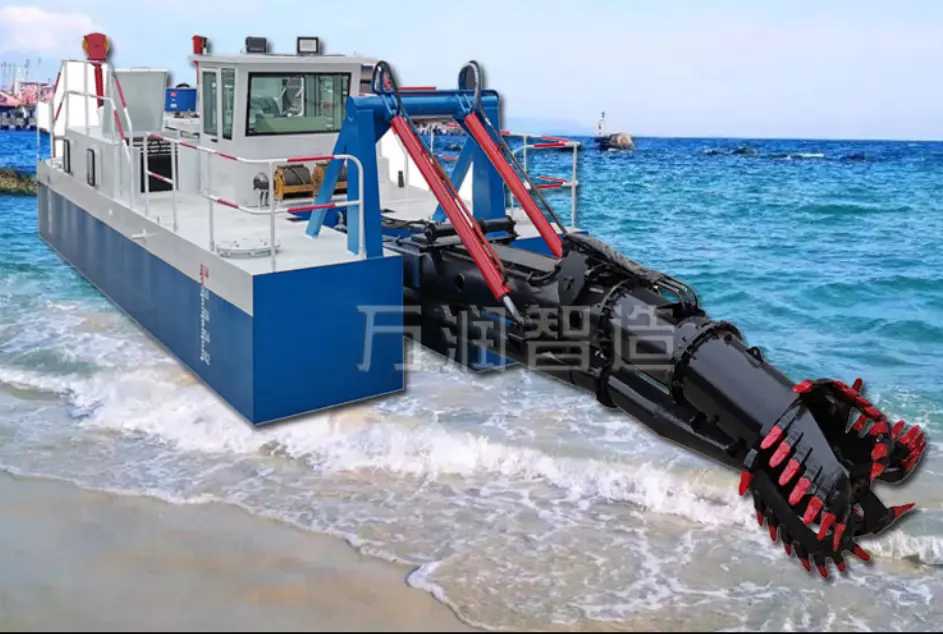
A cutter suction dredger — almost always abbreviated to CSD in tenders and specification sheets — is a stationary hydraulic dredge that excavates soil mechanically and transports it hydraulically in one continuous cycle. The core components are a rotating cutter head, a suction inlet, one or more dredge pumps, a spud positioning system, and a discharge pipeline.
- The cutter head, driven by a hydraulic motor and fitted with replaceable alloy teeth, rotates at the end of the ladder and loosens compacted sand, clay, gravel, or even weathered rock.
- The dredge pump draws the resulting slurry — a mixture of soil and water — into the suction inlet located just behind the cutter head.
- The pump pushes the mixture through a floating HDPE discharge pipeline to the shore, a reclamation area, or a transport barge.
- Two spuds at the stern anchor the vessel, while side winches with anchor wires swing the dredger left and right in an arc. After each pass, the spuds step the dredger forward, so the machine effectively walks its way along the channel.
Because the dredger is fixed on spuds rather than moving freely, a cutterhead suction dredge can hold a very precise dredging profile — a decisive advantage when forming canal banks, harbor basins, or foundation trenches to exact design levels.
Typical Applications for a CSD
Few machines cover as many dredging tasks as the CSD. Common assignments include:
- River and canal maintenance. Working as a river dredger, a mid-size CSD removes accumulated silt and sand, restoring design depth and width without draining the waterway.
- New waterway construction. A CSD is the classic canal dredging machine for cutting new channels, widening bends, and creating turning basins.
- Port and harbor works. Heavy duty dredger classes in the 18–24 inch range excavate approach channels and berthing pockets, including consolidated materials.
- Land reclamation. Pumping sand directly ashore through a pipeline makes the CSD the standard machine for creating new land.
- Sand and gravel winning. In inland waters, CSDs feed wash plants and stockpiles continuously.
- Reservoir and lake desilting, cooling-water intake maintenance, and environmental dredging with precision control.
Key Specifications: How to Size a Cutter Suction Dredger
When comparing quotations, match the machine to your soil conditions, depth, and transport distance. The figures below are typical industry ranges — always confirm exact values on the manufacturer's datasheet.
Production capacity
Capacity is expressed in cubic meters of slurry per hour. Small 6–8 inch units typically deliver a few hundred m³/h; mid-size 10–16 inch machines commonly reach 800–2,000 m³/h; large heavy-duty models in the 18–24 inch class can exceed 3,000–4,000 m³/h under favorable conditions.
Dredging depth
Most CSDs work between roughly 3 and 30 meters. Compact inland units usually reach 5–12 m, while larger ladder configurations extend to 25–30 m for port and coastal projects.
Discharge distance
A standard configuration pumps 800–3,000 m on the dredger's own power. Longer distances — several kilometers — are achievable with booster pump stations, at the cost of extra fuel and pipeline.
Cutter power and soil conditions
Cutter drive power typically ranges from about 50 kW on small inland units to several hundred kilowatts on heavy-duty machines. Hard clay, cemented sand, or weathered rock demand higher cutter power and specialized teeth; loose sand needs far less.
Transport and site access
Check whether the dredger disassembles into truck- or container-sized modules and how quickly it can be reassembled on site. Remote projects often favor designs with bolted rather than welded connections.
CSD vs. Other Dredger Types: Where It Wins and Where It Doesn't
The CSD is not always the right answer. Knowing its boundaries saves money:
- Versus a trailing suction hopper dredger: a TSHD is self-propelled and better suited to loose sand in open water and busy shipping channels; a CSD wins when the soil is harder, the profile must be precise, or material must be pumped directly to a disposal site.
- Versus a backhoe or grab dredger: mechanical dredgers handle very coarse material and debris well, but a CSD is usually faster and cheaper per cubic meter in soils it can cut.
- Rule of thumb: cohesive, compacted, or abrasive soils, precision profiles, and long pipeline discharge point to a CSD; free-flowing sand with long sea transport points to a hopper dredger.
Maintenance Essentials
- Inspect cutter teeth and wear rings regularly; rotate or replace teeth before the cutter body itself starts to wear.
- Monitor dredge pump wear parts — impeller, liners, and suction inlet — and keep spares on site; slurry abrasion is the main cost driver.
- Check spuds, spud guides, and winch wires for wear and corrosion; these parts carry the entire positioning load.
- Keep hydraulic oil clean and watch hose condition; much of the downtime on a hydraulic dredge traces back to contamination or aging hoses.
- Rotate discharge floats and inspect pipeline joints to prevent leaks and uneven wear.